MitoMom Journal
mtDNA genealogy for your unbroken mother line.
Understand your mtDNA results, organize your matches, and start making sense of your mother line.
Lesson 1 · ~5 min read — read your Full Mitochondrial Sequence (mtFull) results and learn what those 16,569 letters actually mean for your mother line.
mtDNA gives us the science. The motherline gives us the story.
Read Letters from the MotherlineInterpreting your amazing and unique test results
The Full Mitochondrial Sequence (mtFull / FMS) reads all 16,569 letters of the little DNA loop your mother gave you — the same one she got from her mother, and so on, in an unbroken chain back to a single woman in East Africa.
Hypervariable Region 1. Mutates fastest. Older mtDNA-only test (mtDNAPlus) starts here.
Hypervariable Region 2. Also fast-changing. Together with HVR1 = the basic test.
Where the haplogroup is truly nailed down. Only the FMS reads this.
The mother line, and only the mother line
mtDNA travels down a single path: mother → child. Sons inherit it but can't pass it on. So your mtDNA matches share a common all-female ancestor — never a man anywhere in the chain.
✅ What mtDNA can tell you
- • Your direct maternal haplogroup (your "deep clan").
- • Other testers descended from your same direct mother-line ancestor.
- • Migration history of that line over thousands of years.
- • Confirmation or refutation of a suspected sister/cousin link on the mother's-mother's-mother side.
🚫 What it can't tell you
- • Anything about your father's mother (her line is its own story).
- • Ethnicity percentages — that's autosomal (Family Finder).
- • How recently you share an ancestor. Even an exact FMS match can be 1 or 20 generations back.
- • Surnames. In naming traditions where women take a partner's name, maternal lines change surname almost every generation — and many cultures use matronymics, clan names, or other systems where the link looks different again.
Sons inherit it too — they just can't pass it on
Reading your mtDNA results
Log in and click into your mtDNA dashboard. Here's what each tab is really for.
Haplogroup & Origins
What it is: Your branch on the maternal tree (e.g. H1a1, U5b2a1, T2b4, L3e3b21b).
How to use it: This is your headline. Read it left-to-right: the letter is the macro-clan, each extra character is a finer twig. H1a1 sits inside H1, which sits inside H.
Matches
What it is: Other testers whose mtDNA is the same as yours or off by a tiny number of mutations.
How to use it: Run Advanced Matches first (see the walkthrough) and download the CSV — that's where your real working list lives.
Matches Map
What it is: Pins for each match's earliest known maternal-line ancestor.
How to use it: Look for geographic clusters. If five exact matches all point to one parish in County Cork, you've found your line's homeland — even without a paper trail.
Ancestral Origins / Country Counts
What it is: Where your matches' earliest mother-line ancestors are reported from.
How to use it: Useful for confirming hunches. Take it lightly — it reflects who's tested, not who actually lived where.
Results / Mutations
What it is: The actual list of letter changes (e.g. T16189C, A263G) vs. the reference sequence (rCRS / RSRS).
How to use it: Copy these into your notes. They're how you'll compare with matches off-site and how citizen scientists assign sub-clades.
mtDNA Journey & migrations
What it is: A visualization of how your haplogroup spread out of Africa.
How to use it: Great for telling the deep-time story to family — but it's about thousands of years, not your great-grandma.
Reading Genetic Distance on the FMS
Genetic Distance = the number of mutation differences between you and your match across all 16,569 positions. Smaller = closer. Here's a working rule of thumb for full-sequence matches:
| GD | Typical meaning | Genealogy potential |
|---|---|---|
| 0 | Identical FMS — same mtDNA letter for letter. | Strong. Common ancestor often within ~5–22 generations. Worth a careful comparison of trees. |
| 1 | One mutation difference. | Good. Could be a few centuries back. Still genealogically interesting. |
| 2 | Two differences. | Possible recent connection, but more often pre-genealogical timeframe. |
| 3 | Three differences. | Usually too deep for written records. Treat as a clan-mate, not a cousin. |
| 4+ | Four or more. | Same haplogroup branch, but the common mother lived a very long time ago. |
A field guide to the big haplogroups
The single-letter prefix tells the deep-time story. The numbers and lowercase letters after it tell the more recent one. (Names follow the PhyloTree / Build 17 naming convention.)
The root of the entire human mtDNA tree.
~40% of modern Europeans. Very common among testers.
U5 is a deep European hunter-gatherer line; K nests inside U.
Spread with Neolithic farming. T2 common in Britain & Ireland.
X has the famous trans-Atlantic distribution.
The classic 'Native American' founding haplogroups.
Superclades almost every non-African branch descends from.
Smaller, regional Northern European branches.
A practical workflow after you log in
- 1
You must upgrade to FMS.
HVR-only results can still be valuable leads — especially when your matches have documented ancestral names and places — but the Full Mitochondrial Sequence is where the real resolution lives. If cost is the blocker, ask in the FTDNA Facebook groups and your haplogroup project: there are FTDNA community groups and project admins who help cover or subsidize FMS upgrades for serious researchers.
- 2
Write down your haplogroup and your mutation list.
Both rCRS-based and (if shown) RSRS-based. You'll want these handy for your research notes and the matrix spreadsheet.
- 3
Join your haplogroup project.
Free. Volunteer admins place you into the right sub-branch and answer real questions. Search 'mtDNA Haplogroup [your letter] Project'.
- 4
Sort with the Mito Matrix Spreadsheet — and triage the old HVR1/HVR2-only testers.
Don't skip the legacy HVR-only matches. Many were tested years ago and never upgraded, but a close HVR1/HVR2 hit with a documented maternal line can still be a valuable lead. Tip: drop the blank matrix plus your Advanced Matches CSV into ChatGPT (or any AI) and ask it to fill the matrix out for you — then spot-check the closest-match rows and pull each match's earliest known maternal ancestor.
- 5
Build the all-female line back from yourself.
Mom → her mom → her mom. As many generations as records allow. This is the line your mtDNA actually tests.
- 6
Build a public maternal-line tree and share it with your matches.
Post your all-female line on a free site like WikiTree, FamilySearch, MyHeritage, or a public Ancestry tree, then send the link to all of your mtDNA matches. A clean 4-generation maternal pedigree they can actually click into gets a reply far more often than 'Hi, we match.'
- 7
Cross-post your mutations on YFull's mtDNA tree.
YFull's mTree is a public mtDNA database at https://www.yfull.com/mtree/ — browsing is free, but submitting your FMS results is a small paid interpretation fee. Worth it to get your sample placed on the tree where a kit-less cousin who tested somewhere else might actually find you.
- 8
Indulge in your FTDNA Discover reports.
Once you've tested, dive into the Discover reports on your FTDNA dashboard — Haplogroup Story, Time Tree, Migration Map, Ancient Connections, and Notable Connections. It's the most fun part of mtDNA testing and it puts your maternal line into deep historical and geographic context.
- 9
Turn on match emails & check in weekly.
In your FTDNA account settings, switch on notifications for new mtDNA matches — then actually log in once a week to look. New testers join constantly, and a line that has zero useful matches today can crack open next year.
Pull your CSV from Advanced Matches
This is the single most useful click in your whole mtDNA dashboard. The Advanced Matches CSV is what feeds the Mito Matrix spreadsheet — without it you're working blind.
- 1
Log in to FamilyTreeDNA.
Land on your kit's home / dashboard page.
- 2
Scroll to "Additional Tests & Tools."
Under the Other Tools row, click Advanced Matches.
- 3
In Filter Advanced View, click Select All mtDNA.
That auto-checks HVR1, HVR2, and FMS together.
- 4
Set "Show only people I match in all selected tests" to No.
This is the triage step — "No" returns everyone who matches you on any of the three levels, so HVR1-only legacy testers don't get hidden.
- 5
Leave Show Matches For: The Entire Database. Click Run Report.
Bump Results Per Page to the max so the export is one file.
- 6
Export / download the CSV.
Save it as YourName_mtDNA_AdvancedMatches_YYYY-MM-DD.csv and drop it into the Mito Matrix spreadsheet.
- 7
Meet the Mito Matrix — here's what you're filling in.
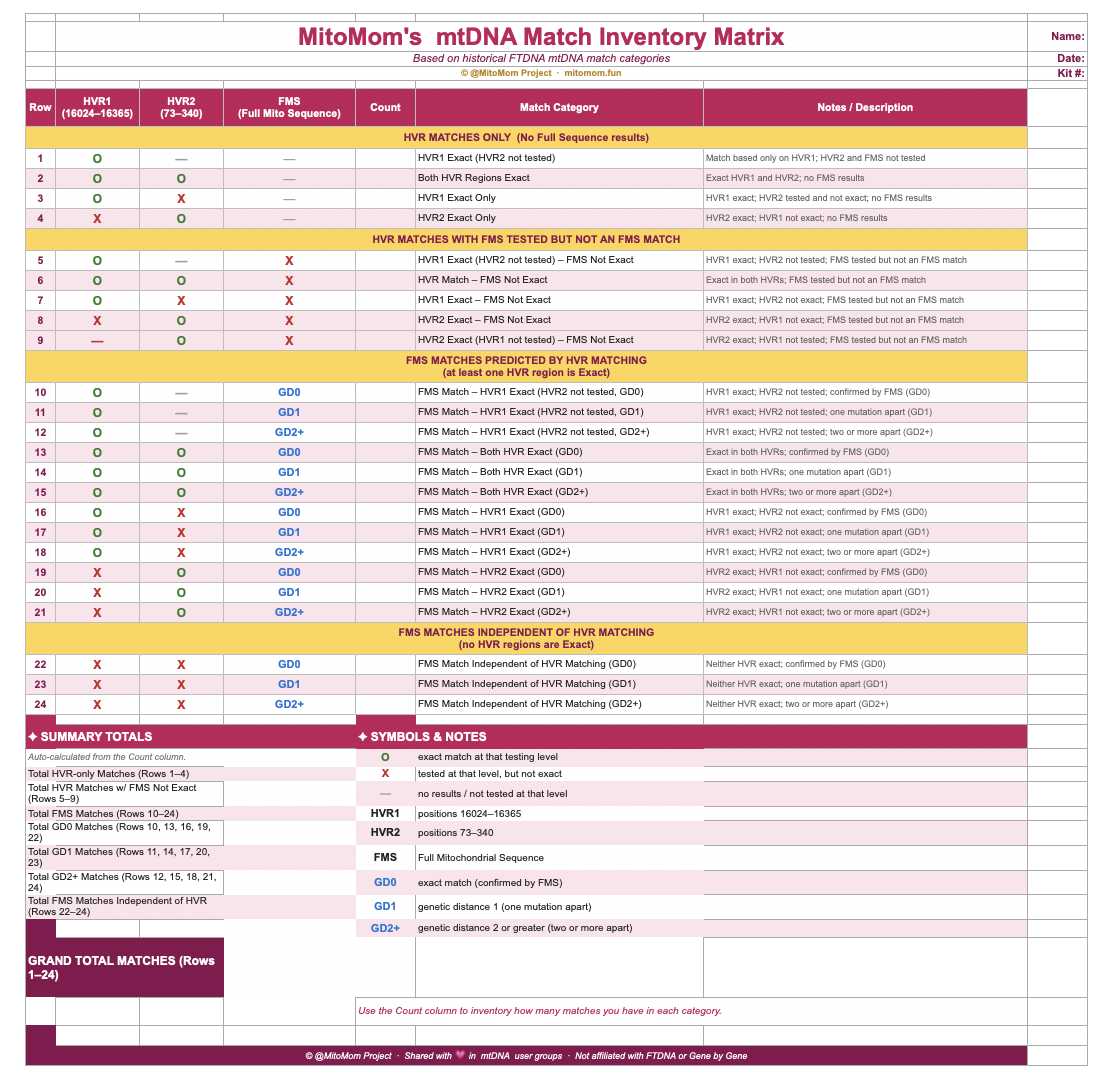
Below is a preview of the blank matrix: 24 rows covering every HVR1/HVR2/FMS match category, plus auto-totaling summary rows at the bottom. Download the .xlsx above and inventory each match into the right row.
mtDNA Match Inventory · Sheet 1 preview
Read-only glance — download the .xlsx for the auto-totaling version.
| Row | HVR1 16024–16365 | HVR2 73–340 | FMS Full Mito Seq. | Count | Match Category | Notes |
|---|---|---|---|---|---|---|
| HVR Matches Only (no Full Sequence results) | ||||||
| 1 | O | — | — | — | HVR1 Exact (HVR2 not tested) | Match based only on HVR1; HVR2 and FMS not tested |
| 2 | O | O | — | — | Both HVR Regions Exact | Exact HVR1 and HVR2; no FMS results |
| 3 | O | X | — | — | HVR1 Exact Only | HVR1 exact; HVR2 tested and not exact; no FMS results |
| 4 | X | O | — | — | HVR2 Exact Only | HVR2 exact; HVR1 not exact; no FMS results |
| HVR Matches with FMS Tested but Not an FMS Match | ||||||
| 5 | O | — | X | — | HVR1 Exact (HVR2 not tested) – FMS Not Exact | HVR1 exact; HVR2 not tested; FMS tested but not an FMS match |
| 6 | O | O | X | — | HVR Match – FMS Not Exact | Exact in both HVRs; FMS tested but not an FMS match |
| 7 | O | X | X | — | HVR1 Exact – FMS Not Exact | HVR1 exact; HVR2 not exact; FMS tested but not an FMS match |
| 8 | X | O | X | — | HVR2 Exact – FMS Not Exact | HVR2 exact; HVR1 not exact; FMS tested but not an FMS match |
| 9 | — | O | X | — | HVR2 Exact (HVR1 not tested) – FMS Not Exact | HVR2 exact; HVR1 not tested; FMS tested but not an FMS match |
| FMS Matches Predicted by HVR Matching (at least one HVR region is Exact) | ||||||
| 10 | O | — | GD0 | — | FMS Match – HVR1 Exact (HVR2 not tested, GD0) | HVR1 exact; HVR2 not tested; confirmed by FMS (GD0) |
| 11 | O | — | GD1 | — | FMS Match – HVR1 Exact (HVR2 not tested, GD1) | HVR1 exact; HVR2 not tested; one mutation apart (GD1) |
| 12 | O | — | GD2+ | — | FMS Match – HVR1 Exact (HVR2 not tested, GD2+) | HVR1 exact; HVR2 not tested; two or more apart (GD2+) |
| 13 | O | O | GD0 | — | FMS Match – Both HVR Exact (GD0) | Exact in both HVRs; confirmed by FMS (GD0) |
| 14 | O | O | GD1 | — | FMS Match – Both HVR Exact (GD1) | Exact in both HVRs; one mutation apart (GD1) |
| 15 | O | O | GD2+ | — | FMS Match – Both HVR Exact (GD2+) | Exact in both HVRs; two or more apart (GD2+) |
| 16 | O | X | GD0 | — | FMS Match – HVR1 Exact (GD0) | HVR1 exact; HVR2 not exact; confirmed by FMS (GD0) |
| 17 | O | X | GD1 | — | FMS Match – HVR1 Exact (GD1) | HVR1 exact; HVR2 not exact; one mutation apart (GD1) |
| 18 | O | X | GD2+ | — | FMS Match – HVR1 Exact (GD2+) | HVR1 exact; HVR2 not exact; two or more apart (GD2+) |
| 19 | X | O | GD0 | — | FMS Match – HVR2 Exact (GD0) | HVR2 exact; HVR1 not exact; confirmed by FMS (GD0) |
| 20 | X | O | GD1 | — | FMS Match – HVR2 Exact (GD1) | HVR2 exact; HVR1 not exact; one mutation apart (GD1) |
| 21 | X | O | GD2+ | — | FMS Match – HVR2 Exact (GD2+) | HVR2 exact; HVR1 not exact; two or more apart (GD2+) |
| FMS Matches Independent of HVR Matching (no HVR regions are Exact) | ||||||
| 22 | X | X | GD0 | — | FMS Match Independent of HVR Matching (GD0) | Neither HVR exact; confirmed by FMS (GD0) |
| 23 | X | X | GD1 | — | FMS Match Independent of HVR Matching (GD1) | Neither HVR exact; one mutation apart (GD1) |
| 24 | X | X | GD2+ | — | FMS Match Independent of HVR Matching (GD2+) | Neither HVR exact; two or more apart (GD2+) |
What we're excited about & hoping to see next
A friendly wish list from the MitoMom community — ideas we'd love to see grow alongside the great work FamilyTreeDNA is already doing for mtDNA.
A Globetrekker-style journey for mtDNA 🌍
Globetrekker has been a beautiful way to watch Y-DNA lines travel across the globe through time, and we'd love to see the maternal line get the same kind of visual storytelling. If you're as excited as we are, share the idea kindly with FamilyTreeDNA — in the Facebook groups, on social, or through their feedback form. The maternal half of humanity has an amazing story to tell, and FTDNA is in the best position to help tell it.
Sharing the mtDNA story with more genealogists 💬
Sometimes folks assume mtDNA isn't useful for genealogy — usually because they haven't yet seen what a full sequence test plus a sorted Mito Matrix and a tidy maternal-line tree can do. Our role as MitoMoms is to gently show them. With good tools and a little patience, mtDNA really does break down brick walls, and every new success story helps the whole community.
A derived maternal haplogroup from Family Finder — coming soon 🧬
FamilyTreeDNA has shared that a derived maternal haplogroup, estimated from Family Finder (autosomal) results, is coming soon — and we're really excited about it. For many people, Family Finder is their first DNA test, taken for ethnicity and cousin matching, and they may not yet realize their direct maternal line has its own story. An autosomal-derived haplogroup would be a friendly first clue — clearly a starting hint, not a replacement for a full mitochondrial sequence (FMS) — and a wonderful on-ramp to real mtDNA testing. Thank you to the FTDNA team for keeping the maternal line visible as Family Finder evolves.
Beyond the Results
mtDNA gives us the science. The motherline gives us the story.
Letters from the Motherline
Imagined notes from the women whose mtDNA traveled mother to child, all the way down to you.
Read the letters
You've found your MitoMom
Now build her story
Log in to FamilyTreeDNA. From your home page, go to Additional Tests & Tools → Advanced Matches. Click Select All mtDNA (HVR1 + HVR2 + FMS), set "Show only people I match in all selected tests" to No, run the report, then download the CSV. That CSV is what you'll drop into the Mito Matrix spreadsheet.
Trouble opening the .xlsx?
- Excel says "corrupted" or stuck in Protected View? Right-click the file → Properties → Unblock, then reopen.
- On Mac, open with Numbers (File → Open) or Google Sheets if Excel isn't installed.
- No spreadsheet app? Use Open in Google Sheets above → File → Make a copy to edit.
- iPad/iPhone: tap the download, then "Open in" → Numbers, Excel, or Google Sheets.
Join the mtDNA groups
The fastest way to get answers is to ask people who already share your branch. Join a few active groups, then drop your full haplogroup string (e.g. H1a1, U5b2a1a1, J1c2b) in an intro post — someone with the same clade almost always chimes in with leads.
- • FamilyTreeDNA User Group (Facebook)
- • mtDNA Haplogroup [your letter] Project on FTDNA
- • Your haplogroup-specific Facebook group (search "Haplogroup H Project" etc.)
- • Genetic Genealogy Tips & Techniques (Facebook)
- • 23andMe Facebook Groups
- • GEDmatch Ancestor Projects
Send MitoMom a comment or message
Have a question, a story, or a correction? Message me on Facebook — I read every one.
Message us on FacebookPrefer email? Write to hello@mitomom.com